




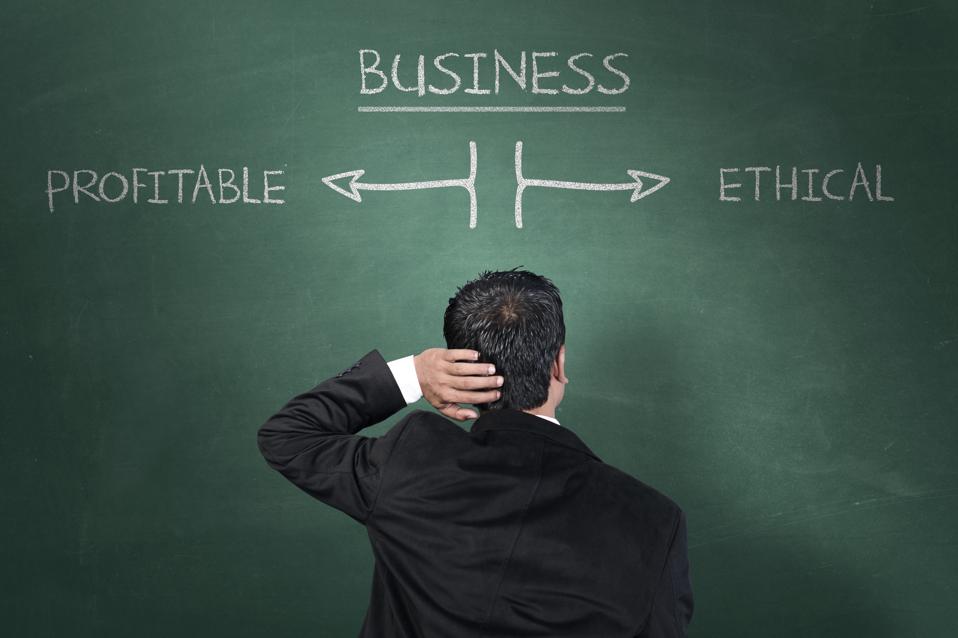
Confused businessman standing in front of blackboard deciding on profit or ethics
getty
The history and the future of ethical decision-making change – or at least morph – every time we bring up the subject. That explains two things:
- It is the area of greatest concern for leaders – and the organizations hiring them – trying to take the long view.
- The risk/reward of these decisions has never been more dramatic.
Leadership at its core, then, is also changing, and with it, its role. Here are five compelling questions and the beginnings of what will be an ongoing conversation about ethics and progresss[.
Six Ethics Questions
- How can we build an organization with ethical values, attitudes, and beliefs that foster ethical behavior at its core? How can we do that when the onslaught of pressures to be unethical are mounting, simply to compete?
- What comes first: invention, assessment, or ethical reins? Do any of these need to be the necessary precedent?
- Are ethical decision-making and competitive risk incompatible?
- How prevalent is the weighing of the pros and cons of being the first or second to take ethical measures?
- Can ethics and progress uphold each other without fail?
- How have questions 1-5 grown in weight over time, especially in this century?
What Is Progress, Actually?
Let’s consider inventions and discoveries of things (like moveable type and dynamite) but not concepts or beliefs (like voting rights and public education), although all are, indubitably, progress. The things we’ll consider must be demonstrable, notable, quantifiable, measurable, equitable, wealth-neutral, and history-worthy. And they must be, to some degree, civilization changers, thus eliminating such popular items as remote-control TV.
We humans have a history of invention and discovery, the only species to claim such distinction. Our very first invention was stone tools, about three million years ago (although this might be considered a discovery rather than an invention, depending on one’s interpretation of the opening scene of 2001: A Space Odyssey).
Stone tools were the first civilization changers. Another couple of million years later came the controlled use of fire. Well over a half million years after fire came the idea of clothing. Through the millennia, we domesticated animals, institutionalized agriculture, developed alphabets, conducted trade (and accounted for it), told time, harnessed wind power, and so forth.
The Choices We Make
The ultimate question herewith is not about what we’ve invented or when we’ve done it. It is, rather, the choice we make in how we use these things.
In the case of absolutely every invention or discovery we humans have ever made, we humans have figured out both constructive and destructive ways to use them. Absolutely every single one.
Why? The answer comes upon considering not just changes, but the nature of change itself. All physical objects that bring changes – telephones, paved roads, toilets, a Roku stick – can be physically measured in three dimensions: length, width, and height. So can their weight be measured. Change, though, cannot be measured that way, but it can be measured.
Measuring The Three Dimensions Of Change
The Nature of Change
Change can be caused by anyone with an idea. Unlike ages, centuries, and millennia past – when change was the domain of the crown or the church, then the highly educated, and later, the world’s first merchants – one could create change through traditional assets: capital, land, shipping lanes, minerals, timber, etc. The wealthy and powerful created change. Today, anyone with an idea has the same potential. Tim Berners-Lee had an idea. Jeff Bezos had an idea. Sergei Brin and Larry Page had an idea. They have all changed civilization.
The Pace of Change
The pace is, as we all observe, ever accelerating. The problem with that is that there is less and less time after one civilization changer then there was after the one before it. The result is less time to think – ethically – about their place in society. Genetic engineering is a case in point.
The Scope of Change
Once a change takes hold, it reaches farther faster than any other before it. It took alphabets 6,000 years to reach from Ur, Athens, Alexandria, and Anatolia to the Americas; it took the internet only 30 years to reach four billion people.
The Position We’re In
Given the nature, pace, and scope of change – along with our demonstrated unawareness of or disinterest in weighing the ethical consequences of our decisions – Ethics will be the single greatest challenge of the 21st century and beyond. And the lack of attention to Ethics will lead to the greatest disaster(s) of all time.
Or we can choose otherwise.
Leadership Lessons, Not Conclusions
So here are six decision points designed not to answer the above six questions conclusively, but to continue fanning the flames and keep the ongoing conversation alive.
- At any given point in history, we are capable of doing more things than we are capable of understanding.
- As more technology is developed that can organize humanity, the more potential we have for chaos.
- If something becomes possible, it becomes expected.
- One step taken in advance is longer than 10 steps to catch up.
- With a set of deeply held principles, you never have to make a decision in your life.
- Making no decision is worse than making a bad one.
So, the one conclusion we can permit ourselves to make at this time is this: If we think about the consequences of our decisions before we make them, we will make better decisions.
link
More Stories
Scott Adams’ AI Resurrection Sparks Backlash and an Ethics Debate
Cultivating Integrity For Long-Term Business Success
Your Foreign AI Vendor’s Black Box Is an Ethics Problem, Not a Technical One