


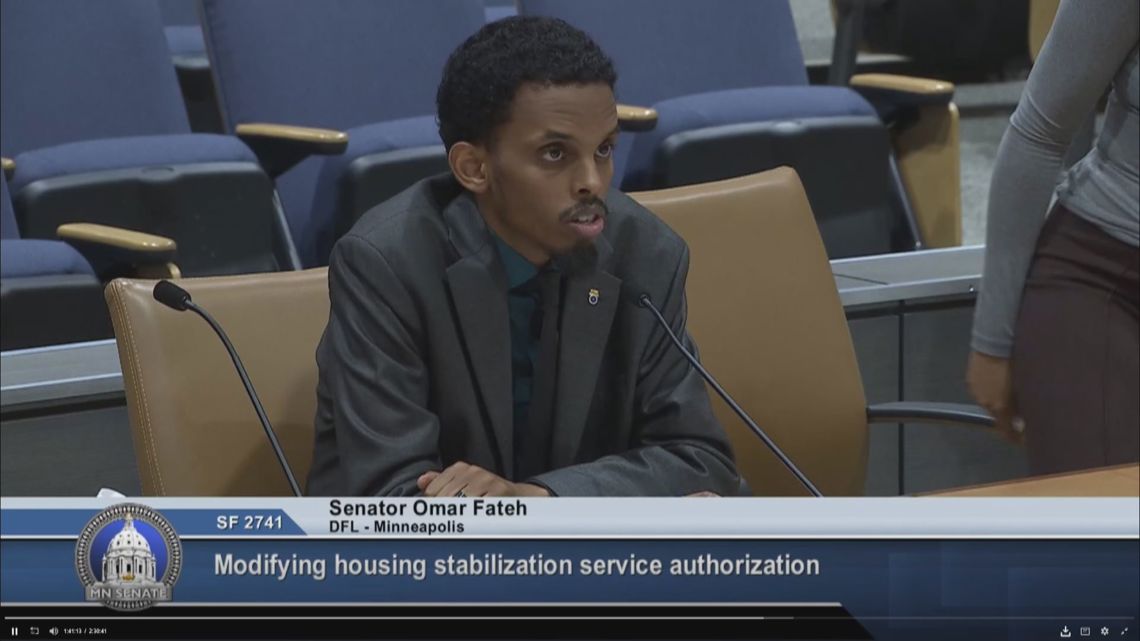
DHS Records show the Senator’s wife listed as the owner of an HSS company when Fateh introduced legislation benefiting the industry.
MINNEAPOLIS — A KARE 11 investigation into Minnesota’s troubled Housing Stabilization Services (HSS) program, which has already uncovered widespread fraud, is now exposing concerns surrounding politics and ethics.
Sen. Omar Fateh’s wife was the listed owner of a Housing Stabilization company while the senator himself was pushing legislation to fast-track client approvals without divulging his ties to the taxpayer-funded program.
KARE 11 Investigates found no evidence of billing fraud, and the HSS company owned by the Senator’s wife did not receive Medicaid money. But a legal expert says the lack of disclosure raises serious ethical concerns.
On March 24, 2025, Sen. Omar Fateh introduced Senate File 2741, a bill he said would speed up access for people to be approved for HSS, a Medicaid-funded program to help the elderly and disabled find and maintain housing.
If passed, it would have shifted authority for approval of housing stabilization services for people with disability waivers from Department of Human Services (DHS) staff to waiver case managers at the counties.
“A bill that will address a critical delay in access to Housing Stabilization Services, also known as HSS,” he told fellow members of the Minnesota State Senate Human Services Committee. “HSS is a lifeline.”
A lifeline moving too slow, Fateh said, because at DHS, there was a months-long enrollment backlog as the agency was overwhelmed by the number of people being signed up.
“Delays that are putting people at risk of eviction, extended homelessness and service lapses,” Fateh said at that March 2025 hearing.
Weeks later, a KARE 11 investigation would expose allegations of widespread fraud in the HSS program, including clients being signed up without their knowledge and Medicaid billed for services never provided.
What was also not known at the time he introduced his bill was that Sen. Fateh had an undisclosed tie to the HSS industry.
“It raises lots of red flags,” said Hamline University and University of St. Thomas political science professor David Schultz, who has taught ethics for 25 years.
Schultz found it concerning that Senator Fateh’s wife, Kaltum Mohamed, was a founder and owner of Community Development Services LLC, an HSS company with an active website soliciting referrals and clients.
“This is a situation where I think almost anybody schooled in, I don’t know, Government Ethics 101 would know that you can’t introduce legislation that benefits yourself,” Schultz said.
Fateh’s campaign staff said that when he introduced the legislation, his wife no longer owned the company, which also never started operating or billing Medicaid.
They pointed to a handwritten note in Secretary of State records dated April 2024 that states, “Kaltum Mohamed is no longer associated with the company.”
However, a Secretary of State spokesperson wrote to KARE 11, “Our office does not record ownership, so this document does not remove someone from a company.” They added, “They wrote that information on the document, but it’s not statutorily required and doesn’t make it official or enforceable.”
More than a year later – just four days after KARE 11’s investigation began exposing allegations of widespread fraud in the HSS program — a separate record filed with DHS listed the Senator’s wife as a “current owner” of Community Development Services LLC.
The record, electronically signed by her and dated May 5, 2025, transferred full ownership of the HSS company to her business partner.
That means she was still officially an owner, at least on paper, when her husband introduced the bill impacting the HSS industry.
“That’s pretty powerful evidence that somebody still is involved with an organization,” Schultz said of the DHS filing.
When asked about the distinction that Community Development Services LLC had not billed for services, Schultz said that it doesn’t affect the ethical issue of conflict of interest.
“I don’t think it has any impact whatsoever. It doesn’t really mean anything whether or not he actually received money. It doesn’t address the issue of a conflict of interest from the day that he introduced this legislation, when his wife was in this business. That’s where the conflict was,” Schultz explained.
Senator Fateh declined KARE 11’s interview request and has not directly answered questions.
However, he posted to social media last week criticizing the Star Tribune, which appears to have contacted him while researching the same story. Fateh wrote in part, “It’s about manufacturing a scandal where there is none,” and the story “insinuates wrongdoing when it’s clear there was none.”
The company, founded by the Senator’s wife, never billed Medicaid. And KARE 11 found no indication of fraud by her or the business.
Senator Fateh’s bill to fast-track access to the HSS program did not pass, never making it out of committee, as lawmakers instead rushed to push through reform measures in the wake of KARE 11’s investigation.
Following federal raids of HSS businesses profiled in KARE 11 reports, DHS ultimately announced plans in August to terminate the HSS program due to out-of-control fraud.
Editor’s Note: Late Tuesday afternoon, Senator Fateh’s campaign staff texted KARE 11 the following statement: “Constituents came to me with this bill which would have empowered counties to actually meet people where they are, with direct, one-on-one in person support and real oversight. That means more people housed, and county staff empowered to catch the fraudsters and bad actors earlier, which DHS has proven unable to do.” -Omar Fateh
link