


Descriptive statistics analysis based on social network
UCINET V6.0 is used to analyze the characteristics of the two networks of Zhengzhou “7.20 Heavy Rainstorm Disaster”, as summarized in Table 2. The visualization results of the network are presented using the R software (Fig. 4).

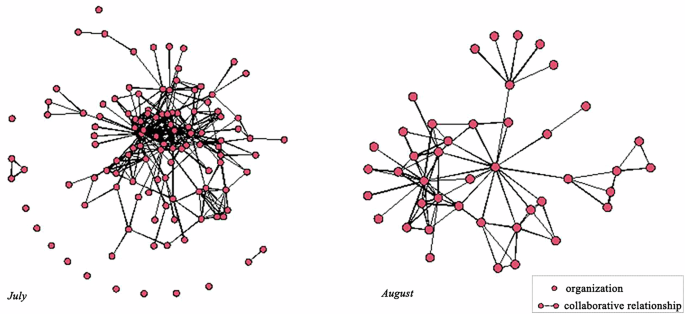
The July Emergency Collaboration Network and The August Emergency Collaboration Network.
The “July Emergency Collaboration Network” comprises 116 nodes and 286 edges. Additionally, the presence of isolated nodes implies that certain organizations have been unsuccessful in establishing collaborative relationships. The “August Emergency Collaboration Network” comprises only 43 emergency organization nodes, with no isolated nodes present. Among the configurations of both networks, Gwdsp is the most abundant, followed by Gwesp, while Gwdeg is the least frequent. The evolution from the “July Emergency Collaboration network” to the “August Emergency Collaboration network” resulted in a notably reduced network size.
The actual effects of the two emergency responses show that the collaboration network in August performed better than that in July. Furthermore, by integrating the results of four indicators: average distance, average degree, clustering coefficient and betweenness centralization, quantitative verification and interpretive discussion of the differences in network efficiency were carried out from the perspective of social network analysis.
The density indicators demonstrate that the “August Emergency Collaboration Network” achieves a higher level of collaboration density within a comparatively smaller network. With an average distance of only 2.862, it signifies that the “August Emergency Collaboration Network” exhibits a heightened level of accessibility among emergency organizations. This suggests a closer inter-organizational collaboration in the “August Emergency Collaboration Network” compared to the “July Emergency Collaboration Network,” leading to smoother inter-organizational communication with faster and more efficient information flow and resource mobilization. Additionally, the results demonstrate that local emergency response organizations have achieved learning in crises. Organizations have proactively optimized and adapted their collaborative relationships by learning from previous crisis experiences. They achieved more efficient disaster response with fewer actors, which significantly increased the efficiency of the emergency collaboration network.
The average degree represents the average number of direct contacts between each organization in the network and other organizations (Myomin and Lim, 2022). The higher the average degree, the more direct the connections between the nodes in the network. In the “July Emergency Collaboration Network,” the average degree is 4.931, while in the “August Emergency Collaboration Network,” it is 3.953. The findings suggest that every emergency organization in both networks maintains an average of at least three collaborative partners, resulting in the formation of star-shaped network configurations. Specifically, certain organizations demonstrated a willingness to establish direct collaborative connections with the maximum number of emergency organizations during disasters.
The clustering coefficient measures the degree of center dependence in an emergency collaboration network. Despite having a smaller network size, the “August Emergency Collaboration Network” exhibits an increase in clustering coefficient to 0.485 compared to the “July Emergency Collaboration Network.” This indicates that the emergency collaboration network develops a stronger tendency to concentrate on the central organization after learning from crises (Kim et al. 2017), leading to the emergence of more closed triangular structures (Robins et al. 2007). Additionally, increased betweenness centralization suggests that the evolved emergency collaboration network is more likely to create multiple cliques connected by brokers. Nevertheless, it is necessary to examine whether the existence of these subnetwork structures serves as a motivation for forming emergency collaboration networks.
In summary, the network characteristics analysis and emergency response performance in reality both indicate that “August Emergency Collaboration Network” outperforms “July Emergency Collaboration Network.” The evolved network exhibits closer and more efficient collaborative relationships. Furthermore, both networks contain multiple subnetwork structures. However, whether these are the key factors that influence the formation of networks with different efficiencies must be further explored using ERGMs.
Explanatory analysis based on ERGM
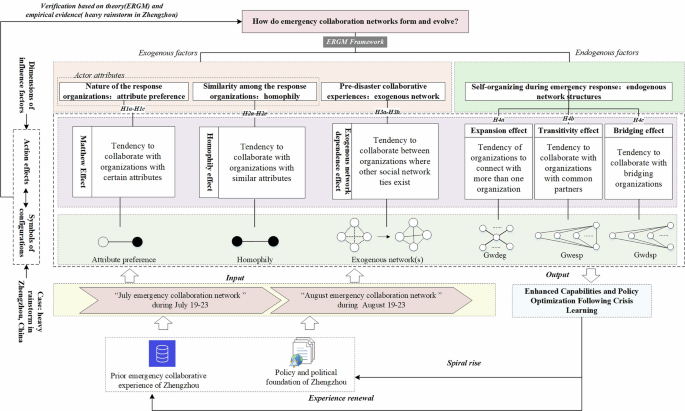
The estimation based on ERGM begins with a null model that includes only the edges as the base stochastic graph model. It can provide a benchmark for comparisons with subsequent complex models. Then, four types of variables, organizational attributes, organizational homophily, exogenous networks, and endogenous network structures, were added to the model sequentially based on Eq. (2). Specifically, Model 1 investigates the influence of attribute preferences on the formation and evolution of emergency collaboration networks; Model 2 incorporates homophily-related variables expanding upon Model 1; Model 3 additionally accounts for exogenous network variables. Model 4 further integrates endogenous network structure variables. In addition, the Akaike Information Criterion (AIC) and Bayesian Information Criterion (BIC) indicators reflect the goodness of fit of the models, and their smaller values indicated that the model fitting results are closer to the actual observed emergency collaboration network (Sharifnia and Saghaei, 2020).
The exponential random graph model of the StatNet package in R software was used for the analysis. Tables 3 and 4 show the results of ERGMs 1–4 for the two emergency collaboration networks, respectively. The detailed statistics in the results of each model are based on the following two principles:
Firstly, they can make the model converge;
Secondly, they can optimize the overall fitting effect of the model.
Factors influencing the formation of emergency collaboration network: Insights from “July”
The ERGM estimation results for the “July Emergency Collaboration Network” in Table 3 indicate a progressive improvement in model fit as evidenced by the decreasing AIC and BIC values from the Null model to Model 4, suggesting that the inclusion of all variable types enhances overall model fit. The incorporation of organizational attributes, homophily, external network, and endogenous structural factors brings the stochastic network closer to the observed “July Emergency Collaboration Network.” Notably, endogenous structural variables contribute significantly to the improved fit as indicated by their substantial impact on reducing both AIC and BIC values in Model 4. This underscores their pivotal role in shaping the formation of the “July Emergency Collaboration Network,” highlighting potential bias if these factors are overlooked. Further, the estimated results for each variable in the emergency collaboration practices in this case are analyzed separately.
-
(1)
Attribute preference effects. The estimated coefficients of each model’s result are significantly positive when the organization type is a nonprofit. This indicates that, compared to government agencies, the participating organizations in the “July Emergency Collaboration Network” prefer to collaborate with nonprofit organizations. But the negative coefficients of state-owned and private organizations indicate that emergency response organizations prefer to collaborate with the government agencies. Thus, Hypothesis 1a is partially supported. It can be inferred that the preference for collaboration with nonprofit organizations may be attributed to their resource complementarity, flexible response capabilities, community trust, and specialized expertise. Evidently, in extreme disasters, nonprofit organizations have become an important addition to the emergency collaboration network that can effectively compensate for government agencies response deficiencies and promote the beneficial expansion of emergency collaboration networks during crises. When government departments fail to function, prioritizing collaboration with nonprofit organizations serves as a temporary measure in emergency situations. State-owned organizations, though resource-rich, are typically subject to centralized allocation through designated platforms and are not the preferred choice for routine collaboration. Private enterprises lack formal participation mechanisms and tend to primarily engage through ad hoc donations. Furthermore, coordination with the army requires strict approval procedures, limiting the frequency of collaboration with other organizations.
The estimated results of other emergency responsibility attributes are not significant compared to command and coordination responsibilities. It suggests that the organizations in the “July Emergency Collaboration Network” prefer to collaborate with others who have command and coordination responsibilities during emergency response. Thus, Hypothesis 1b was supported. This is principally because emergency response organizations are under the unified leadership of an authoritative command organization in China’s crisis management process. Actors can ensure the legitimacy of their emergency response actions by collaborating with organizations that have command and coordination responsibilities. It is beneficial to clear organizational goals quickly and take more effective and clear disaster response actions.
For the results of resource attribute preferences, the estimated coefficients of resource scheduling authority and human or financial resource preferences are both positive and highly significant compared to information preferences. It shows that organizations in the “July Emergency Collaboration Network” prefer to collaborate with others who possess rich resource scheduling authority or human/financial resources rather than rich information resources. Thus, Hypothesis 1c was not supported. The results illustrate that the suddenness of this heavy rainstorm made it difficult to establish effective communication between emergency response organizations. They may be more inclined to accept orders to act quickly and obtain as many emergency resources as possible, such as property, money, and human resources, to accomplish the disaster relief objectives. Therefore, organizations with only rich information resources were not preferred when choosing collaborative partners.
(2) Homophily effects. Homophily variables are included in Models 2–4. The coefficients for both institutional and task homophily are positive, but their significance level is at 5%. This indicates that collaboration among organizations belonging to the same sector or shouldering similar emergency responsibilities in the “July Emergency Collaboration Network” is more feasible to achieve. Thus, Hypotheses 2a and 2 d are supported. However, the types of organizations tend to be diverse. Emergency response organizations not only collaborate with the same sectors but also contact other sectors to access heterogeneous resources. Jurisdictional-level homophily have a significant positive effect, and its estimated coefficient in Model 4 is 0.77 at 1‰ significant level. This indicates that jurisdictional-level homophily significantly increases the probability of contiguous edge generation in the “July Emergency Collaboration Network;” expressly, emergency response organizations in the same jurisdictional level have a strong tendency to communicate and collaborate with others. Thus, Hypothesis 2b is supported.
The coefficient of geographic distance homophily was negative but statistically insignificant. This indicates that geographic distance had no significant effect on emergency response collaboration during the local disaster. This also aligns with China’s institutional environment. As emergency response organizations simultaneously collaborate with response forces inside and outside the disaster area to prevent and mitigate major hazards as much as possible under the special conditions of extreme disasters. Thus, Hypothesis 2c is rejected. In addition, the coefficient of resource homophily is positive but statistically insignificant. It suggests that Hypothesis 2e regarding the effects of resource homophily is not supported. Although the resources are scarce, the type of resource endowments that an organization possesses, whether the same or not, was not seen as an important condition for achieving collaboration during this period of emergency response.
(3) Exogenous network dependency effects. Models 3 and 4 show positive coefficients for both the pre-disaster exercise and plan networks. The coefficients of the pre-disaster exercise network are larger and more significant, at least at the 1% level. The plan network based on a contingency plan is less significant. Thus, Hypotheses 3b are supported, while 3a is partly supported. These results suggest that the pre-disaster exercise network is more effective than the planning network in facilitating the formation of realistic response collaboration networks during extreme disasters. However, the guidance function of the plan network is not adequately performed. It indicates that the problem of operationalization and the effectiveness of collaboration among response actors in a contingency plan still exists. The reasons might stem from the ambiguity in the delineation of rights and responsibilities in the contingency plan, as well as the insufficiency of adaptive training based on the plan.
(4) Structural effects. Since the coefficients of the edges are subsequently negative when the network density is lower than 0.5 (Hunter et al., 2008), the coefficients of the edges in the “July Emergency Collaboration Network” are all significantly negative because this network is sparse. In Model 4, the coefficient of the geometric weighting degree (Gwdeg) is significantly positive. It suggests that the “July Emergency Collaboration Network” has a hierarchical control mechanism that exhibits a star-shaped network configuration. In reality, this structural configuration manifests as centralized coordination hierarchies wherein core command hubs emerge as primary coordination points. Subordinate organizations exhibit preferential attachment to these hubs rather than forming lateral peer-to-peer ties. For instance, the local municipal government establish Emergency Operations Centers to optimize coordination efficiency. An Emergency Operations Center hierarchically directs response units (e.g., Emergency Management Bureau, Meteorological Service, and Urban Administration Department), with all units reporting vertically to the command node. This structure minimizes transaction costs in cross-agency coordination during crises by consolidating decision pathways. Thus, Hypothesis 4a is supported.
The coefficient estimated for the other dependency term, the edgewise sharing partnership (Gwesp), is higher at 1.609 and significant at the 1‰ level, supporting Hypothesis 4b. This suggests that transmissive closure (i.e., the influence of common collaboration partners) is one of the main drivers of the “July Emergency Collaboration Network” connection formation. Although, the estimated coefficients of both Gwdeg and Gwesp are significantly positive, indicating that both structural tendencies, star configuration and transmissive structure, are significant in this network, cross-sectoral collaborative clusters (transmissive structure, Gwesp) play a stronger role in the emergency response during July rainstorm emergency. In actual situations, this transmissive structure manifests as a number of participating organizations with similar emergency response tasks, forming multiple collaborative cliques. Members of the group work in pairs, trust each other and work together to accomplish the emergency response tasks. For example, firefighting teams, armed police, and specialized rescue teams, whose main emergency response tasks are on-the-ground rescue and relief, usually work closely together to search and rescue the affected people after finding them. Rapid and stable information sharing and resource interoperability in the triangular transitivity relationship facilitates the establishment of a strong trust relationship between emergency response organizations. Therefore, these structures have become common and are better choices for emergency disaster response.
The estimated coefficient of binary shared partnership (Gwdsp), which represents the bridging effect, is negative and statistically insignificant. This suggests that organizations didn’t tend to collaborate with bridging organizations in the “July Emergency Collaboration Network.” Thus, Hypothesis 4c is not valid. This is because in scenarios such as emergency response, which require a high degree of timeliness and certainty, there may be a time lag in relying exclusively on intermediary bridging organizations for collaboration. In emergencies, organizations bypass intermediary organizations and seek collaboration directly from other organizations. For instance, during the July rainstorms in Zhengzhou, a “life-saving document” appeared, an electronic document in which people affected by a disaster fill out an online request for help. Rescue organizations could directly locate the disaster site and carry out rescue through the document information, rather than waiting for instructions from a dispatch center. Therefore, the formation of the “July Emergency Collaboration Network ” is not dependent on the bridging effect.
Factors influencing the evolution of emergency collaboration network: Insights from “July” to “August”
Table 4 shows the ERGM estimation results for “August Emergency Collaboration Network.” During the model testing process, the inclusion of attribute preferences in models 2-4 causes the models not to converge, which is against the variable selection principle. Consequently, these variables are excluded from subsequent models. Then, the models converge, and the AIC and BIC values decrease from the null model to Model 4. Model 4, which includes all the influencing factors except for attribute preferences, presents an optimal fit. Among them, endogenous structural factors have a more powerful effect on the formation of “August Emergency Collaboration Network.” Through the comparison of estimation results between “July Emergency Collaboration Network” and “August Emergency Collaboration Network”, we intend to investigate the factors that influence the evolution of emergency collaboration network.
Model 2 and Model 3 show that institutional homophily and resource homophily have a significant impact on the formation of “August Emergency Collaboration Network”. However, in model 4, which includes endogenous structural factors, this impact is significantly weakened, indicating that compared to endogenous structural factors, these factors have a limited explanatory power.
Since the Gwdeg configuration failed to enable the model to converge, the variable was discarded in Model 4 based on the variable selection principle, and Hypothesis 4a was not supported. According to the estimated results from the optimal fitting Model 4, the significant factors that contribute to the formation of “ August Emergency Collaboration Network” are only the “ July Emergency Collaboration Network “ (H3b) and the GWESP configuration within the network structure (H4b). From this perspective, we can arrive at a conclusion that” August Emergency Collaboration Network” represents an advancement of the July network, which serves as a more streamlined collaborative network established on its predecessor’s framework. The results indicate that recent emergency practice experience is a very important factor in promoting the formation of a high-efficiency emergency collaboration network, compared to emergency plans and routine emergency exercises. At this point, the preference effects and Matthew effect related to organizational attributes and homogeneity play a relatively minor role. It is worth noting that the self-organizing form GWESP, which represents the transmission effect, played a vital role in the formation of the emergency collaboration network in both July and August.
Comparative summary
Through a comparative analysis (as shown in Table 5), the influential factors are divided into three groups according to their performance across different periods.
(1) The factors associated with hypotheses supported in both the “July Emergency Collaboration Network” and the “August Emergency Collaboration Network” are likely to consistently play a crucial role in facilitating the establishment of an emergency collaboration network. In this two-stage emergency response case, they are prior experience (H3b) and transitivity effect in self-organizing among emergency responders(H4b). It can be inferred that the normalized emergency exercises collaboration network provides a foundation for establishing collaborative relationships in the initial stage of disaster response, driving emergency response actors to establish emergency cooperative relationships based on their prior exercises. The firsthand crisis response encounters and insights gained from the initial stage of emergency collaboration further enhance the effectiveness of second-stage emergency response collaboration. When Emergency response organizations operate under high time pressure and uncertainty, collaborating with partners who share common affiliates reduces information asymmetry and transaction costs. The “friend-of-a-friend” heuristic enables rapid trust formation, as organizations infer reliability through existing relationships. Transitive triads (closed triangles) create redundant pathways for critical resources and command flows. In the August network, the higher clustering coefficient (0.485 vs. 0.431 in July) indicates strengthened local cohesion, enabling faster response coordination. This aligns with ERGM results showing Gwesp coefficients of 1.609*** (July) and 1.093*** (August), confirming that organizations prioritize partners embedded in dense local networks to mitigate response delays (Lusher et al., 2013).
(2) The factors associated with hypotheses not supported in both the “July Emergency Collaboration Network” and the “August Emergency Collaboration Network” suggest that there is insufficient evidence to demonstrate they have played a role as expected on the formation of emergency collaboration networks during extreme weather disaster response. In this two-stage emergency response case, they are collaborative choice preferences with government agencies H1a and the actor possessing rich information resource H1c, geographic and resource endowments homophily effect i.e., H2c and H2e, emergency plan H3a, as well as bridging effect in endogenous network structures H4c. Combining theoretical analysis and observations of the estimation results in the model-building process of gradually adding various variables, we boldly make the following inference: Resource endowments homophily may hinder the establishment of collaborative relationships (significant but negative in Model 2 and Model 3 of “July”); during the emergency response to Zhengzhou heavy rainstorm, the government agencies failed to fulfill their expected role, and information utilization was suboptimal. This can be attributed to two key factors: first, the region had never before encountered a rainstorm disaster of such magnitude; second, the government’s lack of experience in emergency response led to a fragmented command structure and weak coordination. It was also the part of the accident investigation report that was heavily criticized. At this point, nonprofit organizations became an important addition to the response collaboration network. Collaboration between other organizations and non-profit organizations effectively compensated for the response deficiencies of government agencies and facilitated the beneficial expansion of response collaboration networks during crises. Contrary to expectations, organizations did not tend to collaborate with information resource-rich entities. This reflects the fact that the information-sharing mechanism in the current emergency response practice is not yet sound, and there are information barriers and a disconnect between information and action. Meteorological and geological departments, which have abundant disaster information, are only responsible for releasing information, but it is difficult to directly give participating organizations specific action times and action plans. Meanwhile, it is regrettable that the emergency plan, as a special policy basis, did not play the expected role in guiding emergency coordination during Zhengzhou heavy rainstorm coping. This is worth reflection by emergency management departments.
(3) The factors associated with hypotheses supported in the “July Emergency Collaboration Network” but not supported in the “August Emergency Collaboration Network” show that they have a significant impact on the initial establishment of emergency response collaboration relationships in an emergency scenario, even collaborative efficiency and effectiveness may not always be optimal. However, their impact diminishes in optimizing and evolving subsequent collaboration dynamics. They are H1b (attribute preference related to command and coordination responsibilities), H2a (sectoral homophily), H2b (jurisdictional homophily), H2d (responsibility homophily), and H4a (expansion effect about self-organizing). In July’s initial chaotic response, organizations relied heavily on command-coordination authorities to reduce uncertainty, but August’s network showed reduced dependency. This might be due to crisis learning leading to the institutionalization of collaborative routines replacing hierarchical mandates, emergence of distributed decision-making through cross-sectoral micro-groups, and consolidation of response protocols minimizing the need for explicit command structures. The fading significance of sectoral, jurisdictional, and responsibility homophily indicates that experience-based trust from July’s practical collaboration, and functional integration across organizational boundaries have overridden attribute-based similarity in driving emergency collaboration. The diminished star configuration effect suggests a transition from scale-driven to efficiency-driven collaboration, saturation of critical connections making additional links marginal. It worth noting that although these factors’ influence on the formation of the efficient “August” Emergency Collaboration Network is not statistically significant, they should not be disregarded. We cannot rely on forming efficient emergency response collaboration relationships on a post-disaster damage-control mode every time. Identifying the factors that affect the establishment of initial emergency response collaboration networks in advance, and further implementing targeted improvements and optimizations based on local characteristics can bolster the region’s disaster resilience and facilitate efficient responses in both short-term and long-term disaster management.
Goodness of fit (GOF) test
The Gof test reflects the fit between the actual emergency collaboration network and the simulated network (Wang et al., 2024). Model 4 has the smallest AIC and BIC values, indicating that the model fitting results are closest to the actual observed emergency collaboration network (Howe et al., 2023). Therefore, we conducted GOF tests on Model 4 for the emergency collaboration networks in July and August, and the results are shown in Figs. 5 and 6.

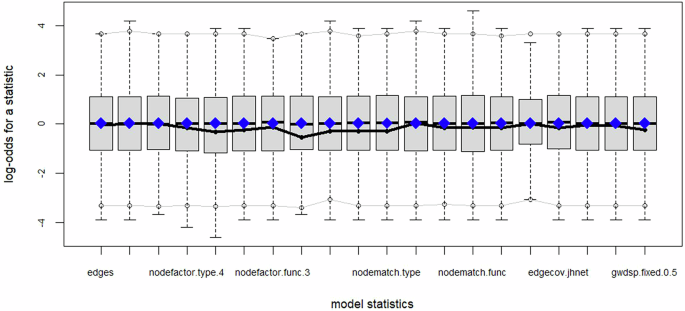
Goodness-of-fit diagnostics results for the “July emergency collaboration network”.

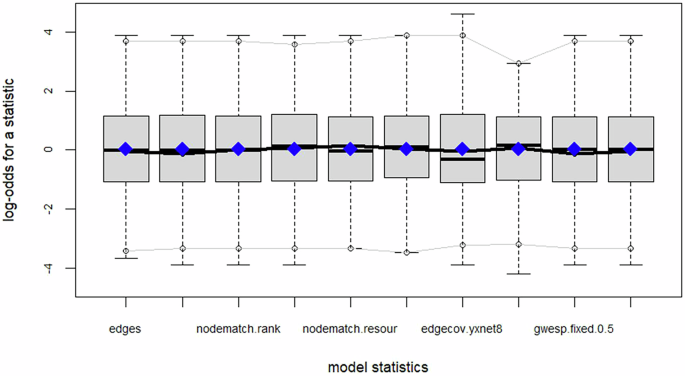
Goodness-of-fit diagnostics results for the “August emergency collaboration network”.
The black solid line in each plot represents the observed statistics for the Emergency Collaboration Network, and the boxplots summarize the statistics for the simulated networks resulting. It indicates that the difference between the actual emergency collaboration network and the simulated network is small, and the model fits relatively well on different statistics with stable estimates. The gray rectangles represent the confidence intervals for each statistical estimate. It can be observed that most confidence intervals are of similar width and relatively compact, indicating that the estimates for these statistics are relatively stable with low uncertainty. The blue diamonds represent the estimated values for each statistic. These estimates are largely clustered around zero with minimal fluctuation, indicating that the model fits these statistics well and produces accurate estimates. The black broken line connecting the estimated values exhibits a smooth trajectory, further demonstrating that the model performs consistently across different statistics without significant abnormal fluctuations.
Robustness testing
When endogenous structural variables are present in the model, Markov Chain Monte Carlo (MCMC) diagnostics are required to assess the reliability of model convergence (Wang et al., 2024). If the model can converge, then each statistical term in the model will behave as a random variation centered on 0. Here, 0 represents the statistical value of the corresponding statistical term in the actual emergency collaboration network. Appendix B and Appendix C present the MCMC diagnostic results for all parameters in Model 4, applied separately to the July and August emergency collaboration networks. Visual inspection of trace plots and density estimates reveals that the majority of parameters display stable, low-autocorrelation traces oscillating narrowly around 0, with marginal distributions closely approximating normality. Collectively, these diagnostics provide robust evidence of convergence and model stability for both networks.
link